DATE
The power to tackle fuel poverty
It’s 2022 and, alarmingly, a rapidly growing number of people in the UK are unable to afford to pay their energy bills and struggling with the increasing cost of living.
Just two years ago there were approximately 3.16 million people in England living in fuel poverty.1 Yet by October this year, National Energy Action predicts as many as 8.5 million households could be in serious financial difficulty from fuel bills. That equates to 30% of homes.
It’s known that people who struggle to pay for their energy and who have a prepayment meter, often self-disconnect or self-ration their energy, allowing their credit to exhaust and disconnect, leaving them without power.2
People are having to make difficult decisions how and where to spend their money. And has led to the trending of the phrase “Heat or Eat’.
Brexit, Covid and the war in Ukraine: The perfect storm
‘Fuel poverty’ is defined as the condition ‘by which a household is unable to afford to heat their home to an adequate temperature.’ It’s caused by the rising cost of living, high fuel prices, poor energy efficiency, unaffordable housing prices and poor quality private rental housing.
Over the last few years, several issues have exacerbated this problem, resulting in potentially far more people struggling to manage their energy bills.
COVID-19 has left many people without jobs and vulnerable; post-Brexit supply chain issues have pushed prices up and reduced buying choice; the impact of the Russia-Ukraine conflict has sent prices soaring across sectors; rising inflation and salary stagnation has reduced disposable income for many; wholesale energy price instability has seen many energy suppliers fail and bills soar.
Energy producers are operating in unprecedented times
Our energy industry participants have obligations to help people in need but they’re dealing with a combination of challenges they’ve never seen before: the consequences of global energy commodity price instability, taking on volumes of customers from failed energy suppliers, managing high levels of consumer debt all whilst juggling several overlapping and complex industry change programmes.
The UK Government has policies in place to steer the energy industry towards a sustainable and secure Net Zero future. However, recent strategy decisions on energy security have not satisfied those who want immediate change to support people in trouble now.
What makes up our energy bills?
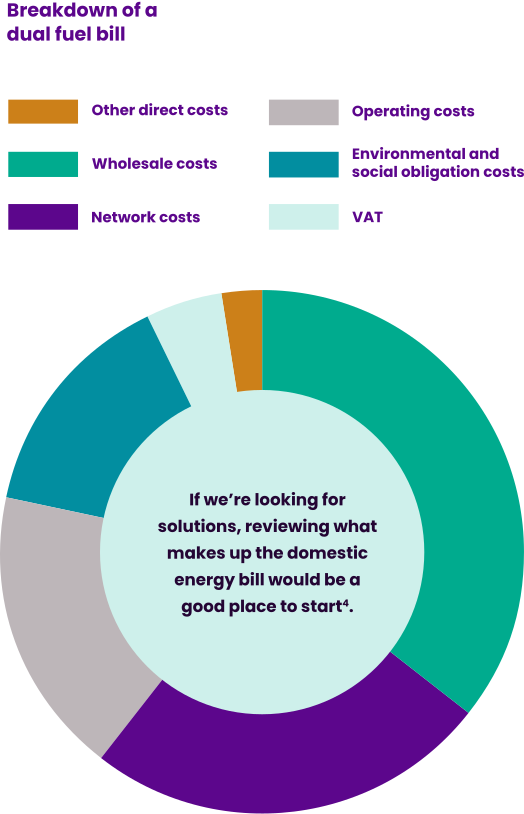
Information correct as of: August 2021
Source: Companies’ consolidated segmental statements
Wholesale costs
Less reliance on imported energy, improved storage domestic capacity and better use of natural resources to generate more, cleaner energy will help to bring this cost down
Network costs
Our networks are undergoing significant change under pressure, to transform into digitalised entities that do more with what we have and make the best use of data. That actually has to happen and quickly to ensure costs are reduced and quality services offered to meet demand.
Operating costs
New, successful entrants have shown how cloud-based CRM and billing platforms can transform how a retailer operates. Overheads have to come down through efficiency gains to reduce this large chunk of cost.
Environmental and social obligation costs
Government and Ofgem are guiding our sector through multiple transformational changes that are to lead to Net Zero nirvana. Lessons need to be learned from the programmes and regulatory periods that have been run to date to apply greater efficiencies to such change. More rapid deployments of change at lower cost has to be the aim.
VAT
Simply put, the VAT paid on energy bills should be reviewed to remove an element of cost.
Six ways ahead
Generally, reforms, targeted efficiencies and all-round improvements across retail, wholesale and networks would provide medium to long term and – importantly – sustainable relief.
Greater control of our end-to-end energy generation, storage and supply will help to reduce the risk of these types of crises being so impactful in the future but the energy affordability problem is here right now and cannot wait for us to transition to a digitalised, decarbonised energy system.
Targeted and sustained support that improves the insulation of our housing stock right now would immediately provide value, both in terms of reducing consumption and therefore bills and also carbon.
Considering standing charges and how they are applied as well as offering time-of-use tariffs to suit specific consumer usage patterns could also offer short-term relief, alongside providing direct bill reduction support to consumers.
Other countries have put in place such measures, with France capping price rises, cutting taxes and offering financial support to combat price rises.
As more consumers now use smart meters, consumption and prepayment top up behaviour patterns are available to provide deep and meaningful insight into whether people are starting to slip into fuel poverty.
Interactions with consumers across all channels and across different energy sector companies offer opportunities to further identify issues and these, plus other, data sources must be combined to offer real help to those that need it.
We’ve digitalised much of our sectors’ systems and processes. Now’s the time for our industry, with the right support from Government and Ofgem, to be making far better use of the data at their disposal to improve identification of those people struggling to pay bills and to offer targeted support.

More about you
From fuel poverty, policy and regulatory change to decarbonisation, the transition to more agile customer-facing technologies and more sustainable energy sources, the energy industry is facing seismic challenges. Whether it is an evolving strategy, defining new operating models, understanding your customer needs, providing delivery assurance or driving through organisational transformation, we can help you define your challenges and deliver the sustainable solutions you need now and in the future.
See some of the challenges we see across the energy sub sectors and the support we’re providing.
If you are passionate about trying to alleviate the fuel poverty problem, we need you!
Please fill in your details below to find out more about an upcoming event we are hosting where likeminded individuals can come together and collectively brainstorm possible solutions.
- https://assets.publishing.service.gov.uk/government/uploads/system/uploads/attachment_data/file/1056777/annual-fuel-poverty-statistics-lilee-report-2022-2020-data.pdf
- https://www.ofgem.gov.uk/sites/default/files/docs/2020/10/self-disconnection_and_self-rationing_final_impact_assessment.pdf
- https://www.gov.uk/government/publications/british-energy-security-strategy
- https://www.ofgem.gov.uk/information-consumers/energy-advice-households/costs-your-energy-bill
- https://inews.co.uk/news/world/cost-of-living-countries-how-dealing-with-crisis-energy-price-cap-cheap-bread-1549648
- https://www.ofgem.gov.uk/publications/breakdown-dual-fuel-bill